
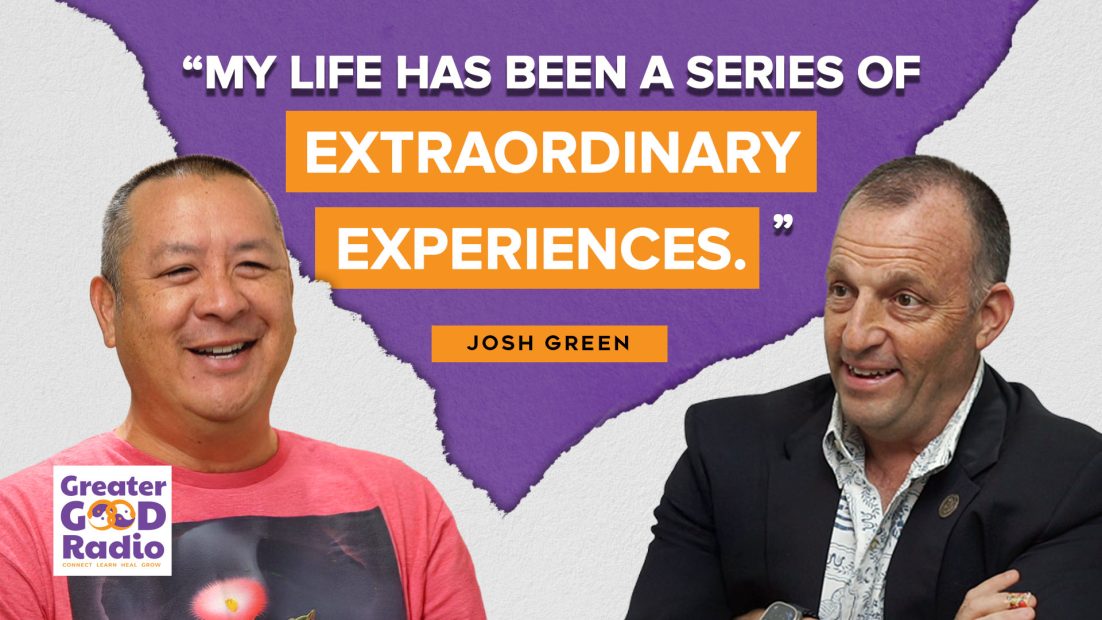
Governor Josh Green’s Journey: From Saving Lives to Shaping Policy
When Josh Green sits down with Evan Leong on Greater Good Radio, the conversation quickly becomes clear: this is not a typical political interview. Instead, it’s a deeply human story about lived experience, service, and how a physician’s mindset can shape leadership at the highest levels of government.
A Life That Almost Took a Different Path
Governor Green’s journey began with a challenge that could have permanently altered his future. As a child, he didn’t speak for his first two years of life. Doctors initially feared a developmental disability—until they discovered he was deaf. After reconstructive inner-ear surgery restored his hearing, he had to fight to catch up academically and socially. That early adversity forged grit, resilience, and a competitive drive that would later define his career.
Rather than limiting him, the experience instilled empathy for those whose lives hinge on timely care and access to healthcare—an understanding that would echo throughout his work as both a doctor and policymaker.
Witnessing Suffering on a Global Scale
At 19, while traveling through India on a research expedition, Green encountered extreme poverty and preventable death firsthand. He saw children die from malaria in the streets and people living with severe disabilities struggling simply to survive. Similar experiences followed during medical missions in Africa, where HIV/AIDS and malaria outbreaks overwhelmed fragile healthcare systems.
These moments triggered what Green describes as a sense of “developed-world responsibility”—a realization that his opportunities carried an obligation to serve. It was then that he committed fully to medicine, vowing not to waste the chances he’d been given.
Becoming Hawaiʻi’s Community Doctor
That commitment eventually led him to Hawaiʻi, where he served as a physician in Kaʻū on the Big Island through the National Health Service Corps. At just 30 years old, Green became the sole doctor for an entire region, caring for patients in a converted plantation house clinic, covering hospice calls, and responding to emergencies with limited resources.
These years were transformative. He wasn’t just treating illnesses—he was becoming part of the community. He learned the true meaning of ʻohana, aloha, and trust. In Kaʻū, medicine wasn’t transactional; it was relational. And those relationships would later form the foundation of his approach to leadership.
Redefining Homelessness as a Healthcare Issue
One patient in particular changed the trajectory of Green’s public service. A homeless woman with schizophrenia repeatedly cycled through the emergency room, not because she needed acute care, but because she had nowhere safe to sleep. Green realized that without housing, no amount of medical treatment could truly heal her.
That insight led him to reframe homelessness as a healthcare issue. Years later, it became the driving force behind Hawaiʻi’s kauhale tiny-home villages—community-centered housing that integrates healthcare, stability, and dignity. Today, more than 20 villages across the state are helping people heal faster simply by giving them a place to belong.
From the Exam Room to the Legislature
Encouraged by colleagues and patients, Green ran for office in 2004—fully expecting to lose. Instead, he won. What began as a way to advocate for trauma services and mental healthcare turned into a long career in public service, from the State House to the Senate, then Lieutenant Governor, and ultimately Governor.
Despite rising visibility, Green never abandoned his identity as a physician. He continued working emergency room shifts for years, grounding his policy decisions in real-world experience rather than abstraction.
Leading Through Crisis: COVID-19 and Maui
Two defining crises shaped Green’s governorship: COVID-19 and the Maui wildfires. During the pandemic, his medical credibility helped him communicate complex health information to the public with clarity and calm. His prior experience vaccinating an entire nation during a measles outbreak in Samoa gave him a rare, firsthand understanding of what coordinated public health action could achieve.
The Maui fires were different—sudden, devastating, and deeply traumatic. Green speaks candidly about misinformation, conspiracy theories, and the emotional toll of leading under scrutiny. Yet he emphasizes that Maui also revealed the power of resilience and community in ways COVID did not. One crisis isolated people; the other pulled them together.
Leadership Without Labels
Throughout the conversation, Green returns to one core philosophy: avoid labels. Rather than framing issues as liberal or conservative, Democrat or Republican, he focuses on practical agreement—healthcare for elders, food for children, safety for communities. His goal is not ideological victory, but trust.
That trust, he believes, comes from authenticity, expertise, and lived experience. As the nation’s only physician-governor, Green brings a rare perspective to leadership—one shaped not by ambition alone, but by service at the bedside.
From Saving Lives to Shaping Policy
Governor Josh Green’s story is ultimately about continuity. The same instincts that guided him through emergency rooms, remote clinics, and medical missions now guide his approach to governance. Policy, in his view, is simply another form of care—scaled up to serve an entire state.
In sharing his journey on Greater Good Radio, Green offers more than a personal history. He offers a reminder that leadership rooted in compassion, experience, and humility has the power to heal—not just individuals, but communities and systems as well.
CLICK HERE to SUBSCRIBE to our YouTube channel
Podcast: Play in new window | Download
Subscribe: Apple Podcasts | Spotify | RSS