
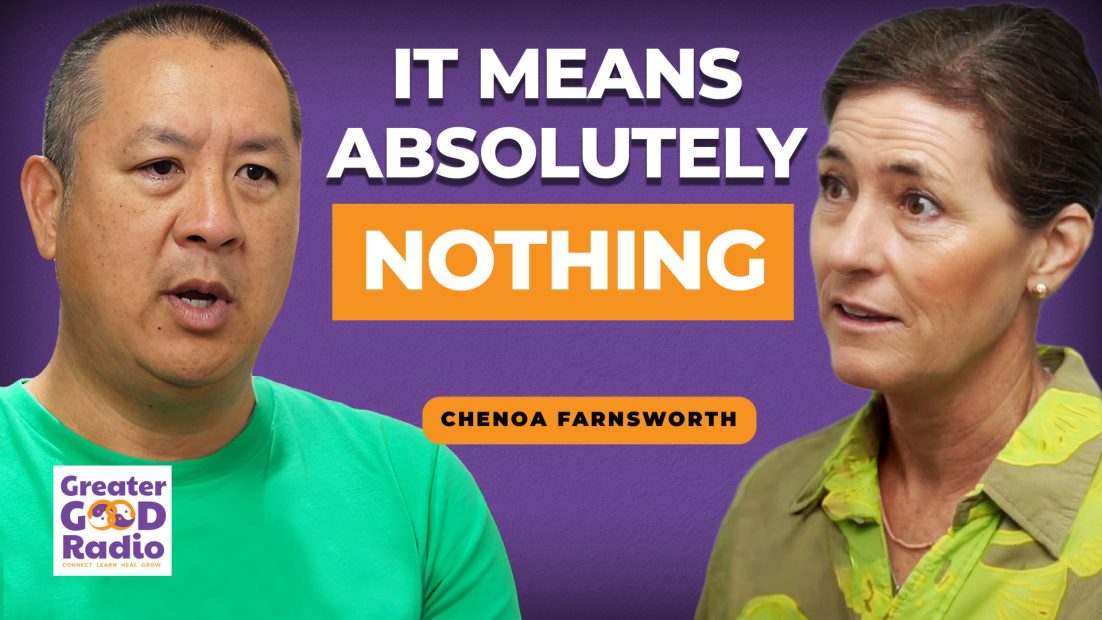
Confronting The Illusion Of Extreme Ambition
Some of the most driven people you'll ever meet are running from something rather than toward it. That's the quiet truth at the heart of this conversation with Chenoa Farnsworth, Managing Partner of Blue Startups, who sat down with Evan Leong for a conversation that moved fluidly between startup strategy and the deeper human questions underneath it. Two old friends who've known each other for nearly thirty years, they used that trust to go somewhere most business conversations never reach: what ambition is actually for, and what happens when we mistake the chase for the destination.
A Winding Road to Venture Capital
Chenoa's path was anything but linear. Her most pivotal childhood moment came at fourteen, when her mother remarried and the family moved from Berkeley to a macadamia nut farm outside of Hōkū on the Big Island — a genuine culture shock that shaped her sense of herself as someone a little different from everyone around her. She left for college at UC Santa Cruz thinking she'd become an international human rights lawyer, then imagined a life in politics, then health policy, with a "big dream" of coming home to work in health administration.
None of those turned out to be the destination. While earning her Executive MBA during the dot-com boom, she realized the tech founders were simply having more fun than the health policy world she'd been immersed in — and she pivoted her entire career. What started as an accreditation consulting practice grew into strategic work with small businesses, and eventually into the venture world where she's now spent more than a decade helping Hawaii founders build.
Why She Walked Away From Politics
One of the sharpest turns in Chenoa's story came when she decided politics wasn't for her. It wasn't a single dramatic moment — a few campaigns that didn't go anywhere, a governor's race that ended in disappointment — but a realization about the nature of the pursuit itself. In her view, politics is fundamentally ego-driven; it doesn't pay well and demands enormous work, so the real fuel underneath it is often something more personal. That early clarity about what drives people would become a lens she'd carry into how she thinks about founders.
The Shame Beneath the Drive
The emotional core of the conversation lands here. Evan, drawing on years of coaching high-level entrepreneurs, offered a blunt observation: the intense drive that powers most founders usually isn't fueled by love. More often it's fueled by shame — the deep-seated feeling of "I'm not enough" — and the accomplishment becomes a way of proving otherwise. I'll show you I'm enough. Chenoa recognized it immediately. The pattern is almost proportional: the bigger the wound, the harder the push, and the more everything gets sacrificed on the altar of achievement.
This is the illusion of extreme ambition. The founders venture capitalists tend to love most are precisely the ones who'll throw their bodies in front of the bus for the outcome — the ones who know in their hearts they should be home with their kids but choose the accomplishment anyway. It's reliable. It's also, as both of them acknowledged, a setup for a reckoning.
When "Success" Leaves You Empty
If ambition is a strategy to meet some deeper need — to feel loved, free, or connected — then the business itself was never really the point. Which is why, as Chenoa put it, someone can accomplish every supposed end goal — sell the company for a billion dollars, take it public — and then fall off a cliff on the other side. The hunt was what got them out of bed every morning. Without it, they're left with an empty shell.
And that's the good outcome. Failure, Chenoa noted, is far more common than success — Blue Startups shuts down many more companies than it celebrates through acquisitions or IPOs — and that journey is excruciating, carrying the weight of having let down everyone in your life, including yourself. Evan's response pointed toward the harder, more honest path: tuning in to what we usually tune out, and turning toward failure instead of away from it, because those moments are often when we're finally forced to address what we've been avoiding.
Treating the Whole Person
Out of this thinking comes something Blue Startups is building deliberately into its work: addressing the whole person, not just the CEO persona or the technologist. Entrepreneurship is a lonely, isolating game, and the pressure on founders is immense. Rather than trying to compete with Silicon Valley on its own terms, Chenoa sees Hawaii's differentiation in creating a space that's safe to talk about balance, health, family, and mental well-being — treating founders more like members of a family than line items in a portfolio. The recognition underneath it is practical as much as it is compassionate: there's a whole human driving the company, and if they burn out, the ability to drive it disappears with them.
The Price of Paradise
Chenoa's own life reflects the tradeoffs she now helps founders navigate. Mid-career, during a financial crisis, she seriously considered a strong VC job on the mainland — until a female VC she was consulting told her plainly that it was a great opportunity if she never wanted to see her kids again. The reality hit hard. She wasn't willing to trade her presence in her children's lives for that role, and she was determined to raise her kids in Hawaii. She calls it the price of paradise — the pay cuts and the missed opportunities that come with choosing community, family, and the culture of the islands over pure optimization for business success.
Even having chosen that path with intention, she's candid about the "mommy guilt" that lingers, and about how much harder these tradeoffs are for women. The sexism she's encountered, she noted, is often subtle and subconscious in the venture world — but in the realm of parenting, it's overt, with people freely commenting on her being an "absentee mom" while her husband handled the school pickups and soccer games.
Bringing the Woo to the Blue
In recent years, Chenoa has found herself on a more spiritual path — not by design, but because it "smacked her upside the head" during a meditation retreat. She's careful with the language, aware that words like spiritual can be a trigger or a turn-off, even for herself until recently. At its most grounded, the practice is about staying regulated — getting more centered and calm, better able to weather what comes without spiraling into anxiety or the old fight-or-flight response. At Blue Startups, they have a phrase for weaving this into the hard-nosed startup world: bringing the woo to the blue.
Making Room for Women in the Room
Chenoa closed on the work still ahead of her: moving the needle for women in venture and leadership. The challenge is real — bring a woman into a room where she's the only one, and she may not feel comfortable enough to stay. Her answer refuses the easy either/or. You have to build safe spaces and infiltrate the halls of power, because being in the room with decision-makers matters too. At Blue Startups, that conviction shows up concretely in the goal of 50% female-founded companies in every cohort — a cohort that deliberately looks a little different from the Silicon Valley template. For women who want to get involved, her advice is refreshingly accessible: joining Hawaii Angels as an investor is more within reach than most people assume, and she's easy to find on LinkedIn.
The Eccentric Underneath
Fittingly, the conversation ended where her story began — with a name. Chenoa is a Cherokee-language word meaning "white dove," the symbol of peace, given to her by her Vietnam War–protesting parents. She's carried a sense of being different her whole life, and while she appears more conformist now, she describes the eccentric, weird little kid she once was as closer to her true self — and predicts she's only heading back in that direction. There's something quietly instructive in that, too. The antidote to a life spent proving you're enough might just be the freedom to be, unapologetically, exactly who you already are.
CLICK HERE to SUBSCRIBE to our YouTube channel
Podcast: Play in new window | Download
Subscribe: Apple Podcasts | Spotify | RSS