
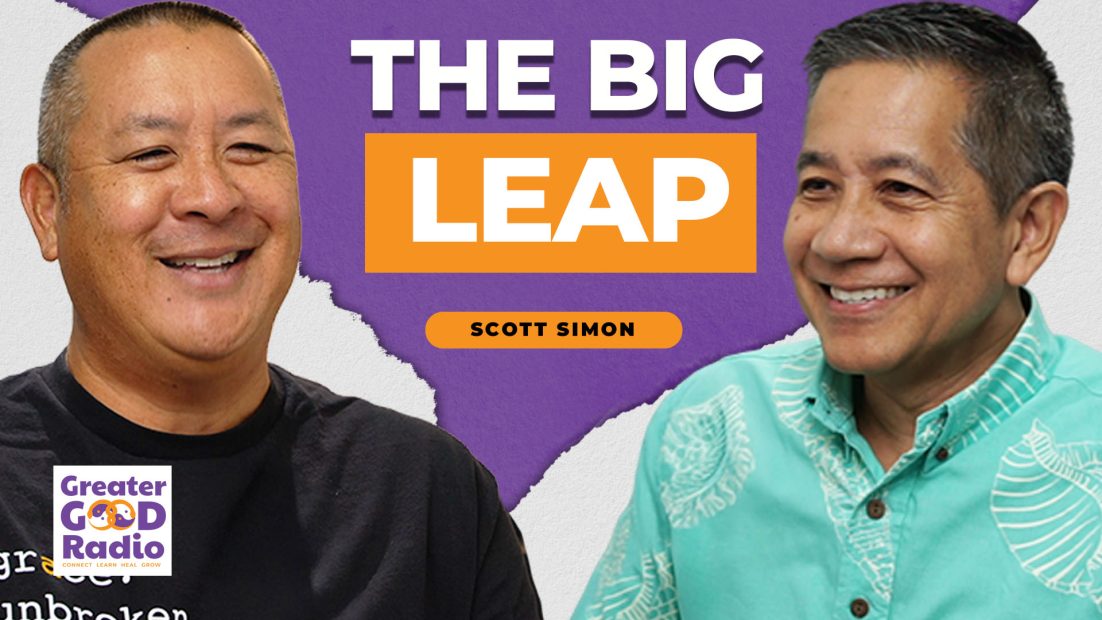
Leaving Executive Pay for Coaching
Scott Simon didn't take a straight line to becoming one of Hawaii's leading executive coaches — and that's exactly what makes his story worth hearing. From growing up in Newtown and attending Waimalu Elementary, to playing volleyball at the Division I–adjacent level at Santa Clara University (after turning down Princeton, no less), Scott's early life was marked by a quiet but consistent drive: do meaningful work, and do it well. He chose engineering out of practicality — he was good at math and wanted to get on with it after four years of undergrad. But even then, mentors were pointing him toward law and medicine, and somewhere in the back of his mind, he was listening.
After earning his law degree from the University of Hawaiʻi at Mānoa's William S. Richardson School of Law, Scott spent years as a litigator before transitioning into in-house corporate counsel roles at Hawaiian Electric and later Hawaiian Telcom. Each stop sharpened something in him. The law taught him to be a tough problem-solver. The corporate world taught him to love advising people from the inside — helping colleagues navigate difficult moments without making them feel small. "I really liked meeting with our internal clients," he recalls. "You could see the load lifted." He didn't know it yet, but he was already coaching.
The Moment He Knew
The turning point came through a coach of his own — a woman named Alison — who introduced Scott to tools he would eventually carry into his own practice. Mind maps. The Can/Should/Want framework. Exercises designed not just to solve a problem, but to help him understand what he actually valued. "Alison equipped me with a lot of clarity," he says. "It made me see — I would love to do that too." He was still at Hawaiian Telcom when the seed was planted, still unsure whether to stay on the corporate path. Then his boss, CEO Alan Oshima, said something that changed everything: This is probably a five-year thing for you. It's probably not your career.
For Scott, that wasn't a dismissal — it was a gift. It meant he wasn't locked in. It meant he could give Hawaiian Telcom everything he had, help reshape the company's narrative during a critical turnaround, and still leave on his own terms. About a year before he departed, he walked into his leaders' offices and told them plainly: "About a year from now, I'm going to be moving on." He gave them time to find his successor. They found one in Su Shin, who went on to become the top communications executive in Hawaii. "That tells me," Scott says, "I made the right move into something that I love."
The Leap — and What It Cost
Leaving executive-level pay with two young kids at home and a teacher's salary as the household's safety net was not a small thing. Scott is candid about it. There was a significant income drop. There was dipping into savings. There was no building the business on the side — when every press release at Hawaiian Telcom had his name and number on it, being on call 24/7, a side hustle simply wasn't an option. So he gave himself a clear, honest goal: get one paid client within six months. If that didn't happen, he'd go back to corporate life, having at least gotten something out of his system.
He exceeded it. By six months, he had multiple paid coaching clients. A friend and former colleague, Lori Tishi of what is now IQ 360, became his first source of work — not in coaching, but as a project sub-consultant — just enough to keep his head above water while the practice took root. "She said, 'I've been where you are. This can help in between.'" That kind of generosity from his network, built through years of showing up — at Hawaiian Telcom, at community boards, at the Downtown Athletic Club — proved to be as important as any credential. By year one, he was also coaching fellows in the prestigious Omidyar Fellows program, an early validation that still carried a dose of imposter syndrome. "I felt like they were getting the most junior one," he admits. But he brought something others didn't: he had just come out of real executive experience, in the real Hawaii business world, and that perspective was exactly what the fellows needed.
Learning to Be a Coach, Not a Lawyer
One of the most honest threads in Scott's story is how hard it was to unlearn the instinct to just give people the answer. As a litigator, you dispense advice. As a corporate executive, you drive outcomes. Coaching is different — it's about asking powerful questions, holding space, and trusting that clarity will emerge through exploration rather than instruction. "Earlier on, I would go into meetings with a scripted plan, like points A through D," he says. Now, it's more open, more curious, more willing to sit with the unknown. He credits the shift partly to his own experience being coached, and partly to the humbling reality of learning the craft in real time.
Today, about 60% of Scott's work is individual coaching, and he holds a tiered pricing approach — lower rates for individuals paying out of pocket, higher rates for organizations, and meaningful discounts for nonprofits, because he believes in the work those leaders are doing and wants to be part of moving the community forward. His coaching philosophy centers on what he calls the "E words": empathy, energy, empowerment, and elevation. But he's clear-eyed about the limits of empathy alone. "If I'm just sitting with them saying, 'Oh yeah, that's super tough,' we don't move." The shift, he says, is toward compassion — feeling with someone, and then helping them act.
No Regrets, Just Evolution
Looking back across a career that spans engineering, law, corporate communications, and coaching, Scott Simon doesn't frame any of it as wasted. He still pays $200 every two years to keep his California engineering license active, not because he plans to go back, but because he values where it took him. The litigation years toughened him up. The corporate years showed him how much he loved developing people from the inside. Each chapter, he says, was a necessary stop on the way to the work he was always meant to do. "I don't regret any of the stops."
What he's built now — a coaching practice rooted in Hawaii, in community, in the deep belief that leaders can and should keep growing — feels less like a career pivot and more like a homecoming. The coaches who shaped him as a young athlete at Newtown Rec, the mentors who introduced him to new frameworks at the right moments, the colleagues who offered a hand when he was just getting started: Scott pays all of it forward, one leader at a time. He even still coaches high school volleyball. Some things, it turns out, never really change.
CLICK HERE to SUBSCRIBE to our YouTube channel
Podcast: Play in new window | Download
Subscribe: Apple Podcasts | Spotify | RSS