
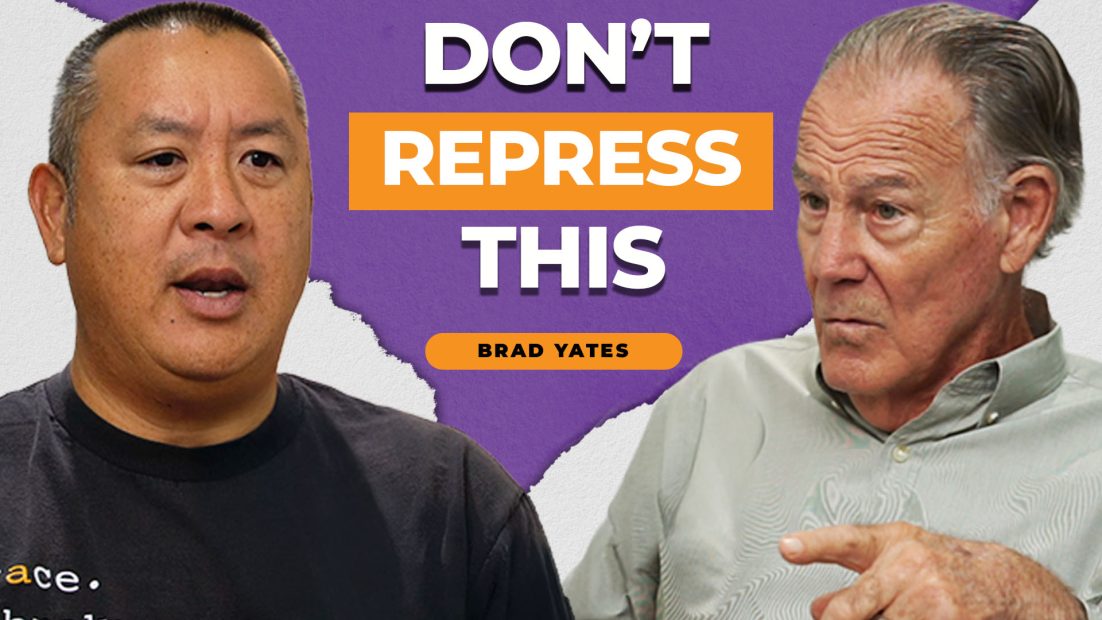
Unprocessed Anger Destroys Elite Leaders
For most of his life, Brad Yates thought he was driven by passion. He played in the SEC, coached at Punahou for thirty years, ran a private practice for twenty-five more, and built the GED framework — Gratitude, Excitement, Devotion — that he still teaches today. From the outside, it looked like fire. From the inside, he eventually realized, a lot of that fire was something else entirely.
"A lot of the gratitude that I had, and a big portion of the excitement that I had, which I thought was passion, was actually anger that had gotten stored somewhere." That single sentence reframes decades of high performance — his and a lot of other people's. And it points at something most leaders never name: the energy they're running on isn't always clean.
When "Passion" Is Actually Stored Anger
Brad's tell was physical. When he didn't like what was happening in a room, his instinct was to headbutt people — sometimes literally, on the field, where he was good enough at it that people asked him how he could hurt someone with his head without hurting himself. The metaphor extends easily into the boardroom and the family dinner table. Plenty of elite operators are still headbutting, just with words, silences, or a particular kind of intensity their teams have learned to brace for.
The problem isn't the energy. The problem is the misdiagnosis. If you label stored anger as passion, you protect it. You feed it. You build a career around it. And then one day — usually in your fifties, sixties, or later — your body, your marriage, or your team sends you the bill.
Suppression, Repression, and the Passive-Aggressive Leak
There's a useful distinction Evan and Brad work through in the conversation. Suppression is when you know the anger is there and you push it down. Repression is when you've pushed it down so completely you don't even know it's there anymore. Both create the same downstream problem: the energy doesn't disappear, it leaks.
In leaders, that leak almost always shows up as passive aggression — the pointed comment in the all-hands, the loaded silence in the one-on-one, the email sent at 11 p.m. with three people CC'd who didn't need to be. Anger is agency. When it can't move forward cleanly, it moves sideways. And sideways anger is corrosive to the exact thing leaders are paid to build: trust.
The Cost Compounds Quietly
Brad tells a story about a play from 1963 — a quick kick against Alabama. He neglected to block his man, then made the tackle in the end zone on national television. He thought he was on fire. The next Monday, watching film, his coach called out exactly what he hadn't done. Decades later, doing a reframe exercise with a colleague at Punahou, that same anger — at himself — came right back up, fully intact, as if no time had passed.
That's the part most people underestimate. Unprocessed anger doesn't fade with time; it files itself away and waits. Brad's question is the one every leader should sit with: "For someone that gets angry on a habitual basis, how much of that gets stored, and what does it do to your health?" The answer, in his experience, is: a lot, and more than you think. The price of not liking your job, not liking your situation, not liking yourself — and never processing any of it — is huge.
Anger as Agency
The reframe that changes things is this: anger isn't the problem. Repressed anger is the problem. Healthy anger has a job. It tells you where a boundary is needed. It gives you the agency to move forward — to make a hard call, to leave a bad fit, to say the true thing in the meeting. Without it, fear has nowhere to go and you're left with helplessness dressed up as patience.
Evan describes what this looked like in his own grief work: once he let the grief move through, anger showed up next, almost on cue, and once he let that be felt, he could finally move forward. That's the sequence elite leaders rarely give themselves permission to run. They skip the grief, skip the anger, and try to lead from a sanitized "positive" place — and then wonder why their team can feel the static under everything they say.
What Processing Actually Looks Like
Brad's protocol is almost embarrassingly simple, which is probably why it works. Breathe through your heart. Notice the energy that isn't pleasant. Keep breathing until it becomes intensity. Keep breathing until you can find the passion underneath — and then figure out, deliberately, how to express it in your life. That's it. No catharsis theater. No yelling into a pillow. Just enough presence to let the energy finish its job instead of getting stuck.
The other half is people. Brad credits his ability to see his own anger to working with people who could reflect it back to him without flinching. Elite leaders almost always have a gap here. They have advisors, boards, coaches, and chiefs of staff — but very few of them have someone whose actual job is to tell them: Hey, that wasn't passion. Pay attention. Building that bench, and letting those people do their work, is one of the most leveraged moves a leader can make.
The Bottom Line for Leaders
The leaders who flame out late in their careers rarely do so because they ran out of talent. They flame out because thirty years of stored anger finally caught up to their bodies, their relationships, or their judgment. The leaders who finish strong — the ones Brad is studying now as he writes his coach's manual at eighty-four — almost all share one trait. They learned, somewhere along the way, to tell the difference between fire and stored heat, and they did the unglamorous work of clearing the second one out.
That's what it means to operate at HiLevel. Not to be calmer. Not to be more positive. To be honest enough with yourself about what's actually fueling you that you can choose, day by day, what you want to run on.
CLICK HERE to SUBSCRIBE to our YouTube channel
Podcast: Play in new window | Download
Subscribe: Apple Podcasts | Spotify | RSS