
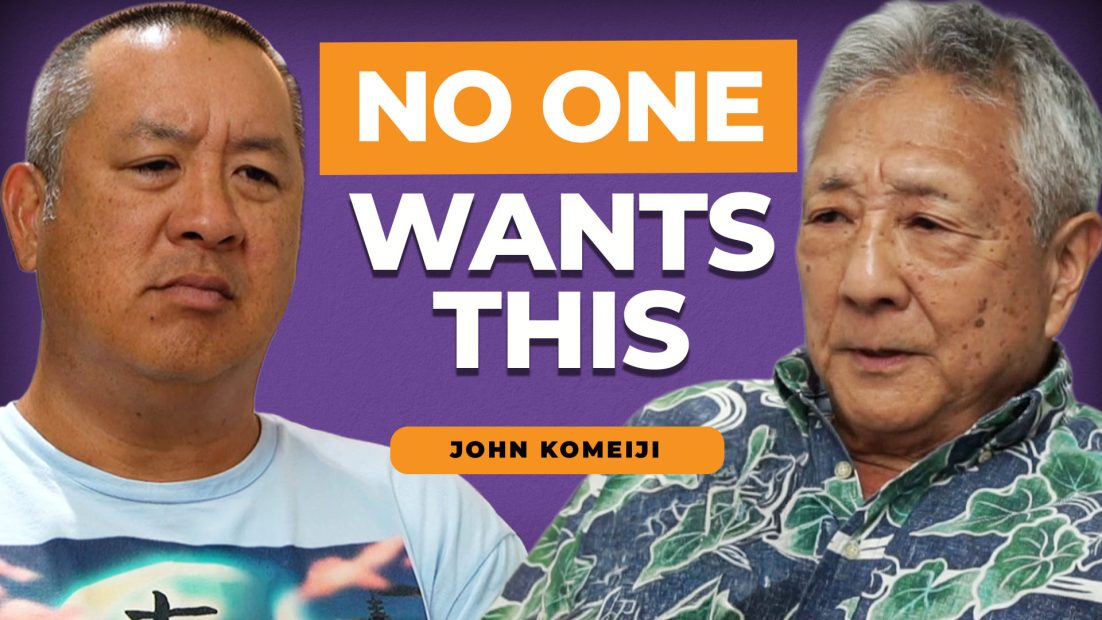
I Volunteered For Hawaii’s Hardest Job
John Komeiji has spent a career doing things that weren't supposed to happen to "somebody like me." A barely-passing high school student who was headed for a job as an auto mechanic became a trial lawyer for three decades, then general counsel of Hawaiian Telcom, then its president and general manager, then general counsel and vice president at Kamehameha Schools. Now he's taken on what he calls the hardest thing he's ever done: serving as the first volunteer chair of the Mauna Kea Stewardship and Oversight Authority, the body charged with taking over management of one of Hawaii's most sacred — and most contested — places.
On this episode of Greater Good Radio, John sits down with Evan Leong to talk about mentorship, culture, conflict, and why a man with nothing left to prove would take on a job with no pay, no roadmap, and no shortage of people willing to call him foolish for trying.
The Chosen One
John doesn't credit talent for where he ended up. He credits people — the mentors who invested in him for reasons he still can't fully explain. Chief among them was a family friend he called Uncle Keiji, who talked a teenage John out of becoming a mechanic, then out of teaching, and steered him toward law school before John even understood what law school was.
Years later, someone from his childhood told him, "We used to wonder why you were the chosen one" — why Uncle Keiji spent his time on John and not the other kids. John has never landed on an answer. But somewhere along the way, the question turned into an obligation. All those people had invested in him. He decided he was supposed to do something with it.
Becoming Rocky
The film Rocky came out during John's second year of law school, and he's carried its lesson ever since. You might be behind in raw skill against whoever you're up against, but if you build focus, create structure, and have the discipline to stick to it, you can hang with anyone. He's spent his life as the self-described underdog, out-preparing and out-working the gap between himself and the people across the table.
That approach shaped an unlikely legal career. Slotted into trial work — which, he admits, suited his personality far better than transactional law ever could — John came to see the courtroom as a teaching exercise: his job was to help a jury adopt his side of the story. It's a thread that runs through his whole life, from a mother who taught elementary school to a degree in education to a instinct for solving problems rather than simply winning them.
The Job Nobody Envied
When the state created the Mauna Kea authority, it did something unusual: it seated eleven people who had often stood on opposite sides — Kia'i who had physically blocked the road, astronomers, business leaders, and voices from the community that had never held any power before. John was appointed to chair a group in which he knew no one, and where some members were openly distrustful of his business background.
There was no staff, no template, and no salary. He was writing job descriptions, learning how the state's financial system worked, testifying at the legislature, and building an organization from nothing — largely by himself. To even understand the issue, he spent months watching recordings of old hearings and reading through thousands of pages of documents. By his own honest assessment, it was really, really hard.
Trust Is Built By What You Do
John is careful to say he doesn't have the answer for Mauna Kea. What he has is a conviction about how to look for one. He worries that Hawaii is drifting toward divisiveness — people living in silos that bang against each other, with less and less understanding of where the other side is coming from. Mauna Kea, in his lifetime, may be the most divisive issue the community has faced.
His job, as he sees it, isn't to force a vote or declare a winner. It's to build a platform where deeply opposed people can sit in the same room, trust and respect one another, and be transparent about why they do what they do — even when they don't agree. Trust and respect are his only non-negotiables, and he's clear that neither is built overnight or by decree. They're built by what you do, not what you say. Getting astronomers and Kia'i into the same room may sound modest, but it's a step that once seemed impossible.
The Culture Work
The blueprint for this comes straight from John's years at Hawaiian Telcom, where the project he grew most passionate about wasn't legal or financial — it was employee engagement, which he defined simply as wanting people to feel like they belong. His biggest learning: employee-to-employee conversations carry far more weight than management-to-employee ones.
So he handed the work to the employees themselves. He picked small groups, gave them a single instruction — decide what you think matters and tell the rest of the company — and promised not to censor a word. Groups shared the company's proud history, interviewed coworkers about why they showed up every day, and moved people to tears. One finance employee told John his wife always knew when it was Wednesday, because that was the night he got excited about Thursday's meeting. For John, leadership wasn't about generating the ideas himself. It was about inspiring people, giving them real authority, and clearing the obstacles so they could do the right thing.
The One Thing He'd Change
Asked about his proudest accomplishment, John deflects — maybe it hasn't happened yet, maybe this isn't it. But asked what he'd change, he doesn't hesitate. In his first five years supervising people, he says, he was too harsh, too driven, and basically a jerk. Some of those people would tell you he taught them a great deal, and he believes that. But he also believes he could have taught them the same lessons in a better way, without the cost to the people on the receiving end.
It's a striking admission from someone taking on a job defined by human relationships — and maybe the clearest sign of why he's suited to it now. The man who once needed to be the best in the room so no one could fire him has become someone whose entire strategy rests on trust, humility, and the patience to let other people find their voice.
A Platform For The Next Generation
John is realistic about the limits of what he can accomplish. Mauna Kea is a generational issue, and he may not be the person who ultimately resolves it. His goal is more modest and, in a way, more selfless: to set the platform so that someone else can one day figure it out. Somebody has to try, he says, or nothing moves at all. Maybe they fail — but at least somebody tried.
He knows how the effort looks to some. Plenty of people have called him foolish for taking it on, including good friends. One even carved him a plaque with a single word on it — bakatare — and told him to look at it every morning to remember who he truly is. John keeps it. It's the kind of humor that only works among people who trust each other completely, which is, fittingly, exactly what he's trying to build on the mountain.
CLICK HERE to SUBSCRIBE to our YouTube channel
Podcast: Play in new window | Download
Subscribe: Apple Podcasts | Spotify | RSS