
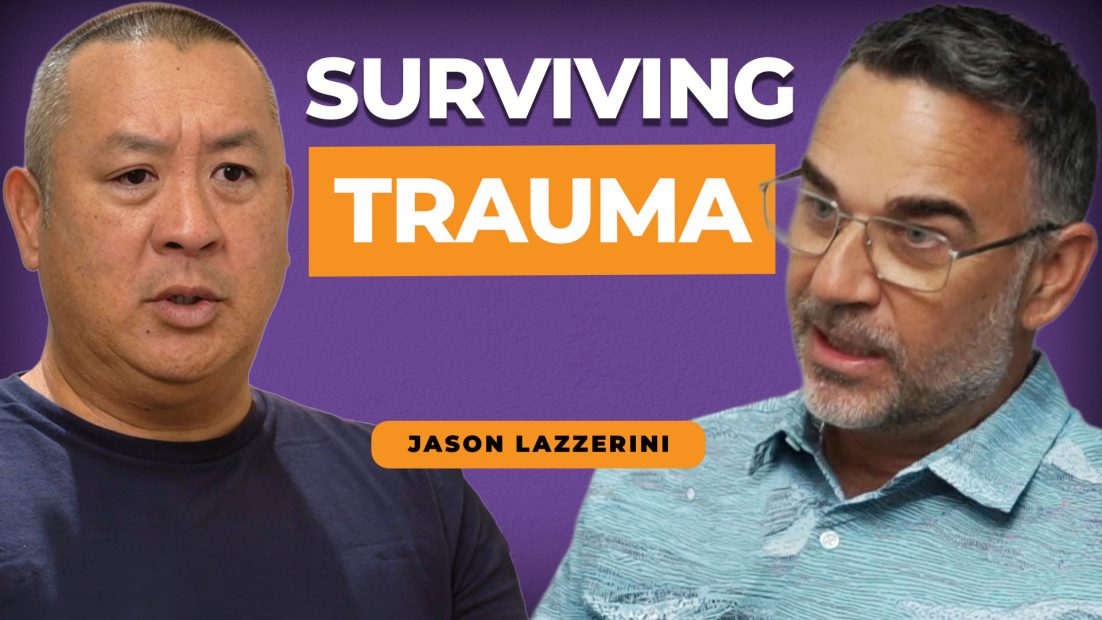
Why Successful Leaders Self-Sabotage | Jason Lazzerini
Jason Lazzerini has built a life many people would envy. He is executive vice president and chief digital officer at Central Pacific Bank. He teaches in the University of Washington's Pacific Coast Banking School graduate program. He is a novice paddler at Outrigger and a father of three who is home most nights to cook dinner. He is also, in his words, a "recovering professional musician," a jazz saxophonist who spent his early twenties playing on cruise ships around the world.
When Jason sat down with Evan Leong on Greater Good Radio, the conversation kept returning to one question: why do capable, accomplished people make choices that unravel the very lives they worked so hard to build? His answer, and Evan's, has less to do with strategy and more to do with what's happening underneath.
When Everything Looks Right From the Outside
Jason points to a story that went viral: a CEO of a major company caught on camera at a concert, publicly carrying on an affair with another executive. "You have everything," Jason says. "Just think about stacking up those bad decisions and what's gotta be going on underneath that to be causing somebody to torpedo a beautiful life they've taken all this time to build."
Evan puts it simply: when a need goes unmet, we find a way to meet it unconsciously, often in ways that hurt us. Jason agrees, and he sees it at every level. "I think it's a problem from top to bottom," he says. The intern and the executive face the same risk. Each can chase something without understanding why they want it.
The Problem With Low-Resolution Goals
Every year, Jason sits down with the bank's college interns and asks them, without warning, what they're aiming at. The answers range from "I just wanna be happy" to "I want to be an investment banker at Morgan Stanley." What strikes him is that even the specific goals are "low resolution." The interns know the target, but not the need driving it. "If you're chasing investment banker 'cause you want status or you want money and you hate the job, you'll be very miserable," he says.
When he peels back the layers, he often finds the same deep desire: to come home to Hawaii, own a home, raise a family, and give their kids a chance. Evan pushes him on whether this is any different for the people Jason leads. Jason admits it isn't. "That's why I'm interested in this leadership piece," he says. "I feel like it's very missing."
Holding Two Poles: Desire and Service
Jason's working theory is that a meaningful life requires balancing two forces. The first is desire. "It's okay to desire something or to want it, whether it's to be safe, whether it's to have status," he says. "Just identify what it is that's driving you." The second is service, the responsibility to something larger than yourself. Neither one ever gets settled. "You never get to stop thinking about it," he says. You keep adjusting between them, like a pilot making small corrections between Hawaii and Las Vegas.
He adds that we have to be stewards of our future selves, too, and not leave our problems for "future Homer," as he jokes. Evan offers the other side: we also have to be stewards of our past selves. The younger parts of us, and sometimes the generations before us, carry patterns that keep repeating until we address them.
The Patterns We Carry
Evan describes coach Joe Hudson's "golden algorithm": the way we try to avoid a painful feeling ends up inviting it back in. Someone who fears abandonment pushes people away, then feels abandoned when they leave. Evan learned this firsthand when he teased his son for sounding like Evan's father. His other son corrected him: "He sounds like you." These patterns follow us from home to home and job to job. "Your shadow goes with you," Evan says.
Jason knows his own shadow. His stepdad held him to fierce standards. He wouldn't let Jason say what something was "like" when he could name what it was, and he made Jason split the cost of a desk with his paper route money in the Chicago winter. That discipline made Jason a clear communicator. It also left him wary of risk, slow to show vulnerability, and still wrestling with the fear of rejection. During one of the hardest stretches of his career, distracted and already upset, he yelled at his toddler son for running into the street. "As soon as I did it, I just felt like shit," he says. "I knew where I came from, and I knew that wasn't who I wanted to be."
The Father Who Never Came Back
Jason grew up without his biological father. He spun stories as a child that his dad was a soldier doing something important, anything that meant his absence "wasn't about me." His father had served three tours in Vietnam and earned two Purple Hearts, but he was never able to hold his life together. When Jason was about 10, his mother asked him to end contact, and he did. In his thirties, Jason went looking for the "unfinished business" in the dark corner of his life.
He found his father living in a trailer park in Michigan, looking far older than his years. "Talking to him was like talking to a teenage kid in a 60-year-old body," Jason says. He held it together during the visit, then broke down in the car. "He never came back from Vietnam." Instead of the closure he expected, Jason found gratitude for his mother's courage and for the stepdad who chose to raise him. "For a kid whose wound is 'I'm not enough,' I got somebody who didn't have any biological reason to love me, who did," he says. "There's no more irrefutable proof."
Thinking Versus Feeling
The past few years have brought heavy loss. Jason's biological father died, and later his stepdad died after a long illness. A month after that, his mother-in-law passed away suddenly, the day before his dad's funeral. Jason admits he has a "challenging relationship" with his grief. "I feel like I should cry more," he says. He tends to intellectualize, and he's reading Thomas Mann's The Magic Mountain, a novel about escaping the world through the intellect, because it resonates.
Evan offers a reframe that stays with Jason: grief's job is to reconnect us to the love we lost, in its new form. "You can't think your way out of feeling," Evan says. Thinking often numbs or distracts us from what's underneath. Evan shares that he recently caught himself sending his high school senior a stream of uninvited college plans. When he looked closer, the planning was covering sadness that she's growing up and leaving home.
Self-Governance Comes Before Leadership
For Jason, the antidote to self-sabotage is order. First comes a compelling aim. Then you have to operationalize it: break it down, build plans, and create an operating rhythm that carries you through the ups and downs of life. "There's always a flood coming," he says, "and you should be building an ark. An ark is your character."
Only after that, he says, have we earned the right to lead others. "If you can't keep your life in order, what business do you have telling 12, 15, 30, 100 people how to manage their lives?" Some leaders pour everything into work and let the rest fall apart. They may cross the finish line, Jason says, "and everything falls off at the end." He believes it works for almost no one and leaves people "very sad at the end of that journey."
Building a Life That De-Risks Regret
Jason hates the feeling of regret. In fourth grade, he skipped band tryouts to play soccer at recess, then spent the whole year watching the other kids carry their instruments. The next year, he skipped recess and got his instrument. As an adult, he left cruise ships after watching brilliant musicians in their forties become stuck and sad. He chose a career with no client dinners or travel so he could be home for dinner, and he moved his parents to Hawaii when his kids were born. Evan names the pattern: "You minimized the risk on your regrets." Jason laughs. "I'm gonna write that down."
It shows. On Father's Day, Jason sat in the sand at Outrigger with his family after swimming out to the buoy with his twins, and he felt overwhelmed with gratitude. Evan recalls that when he asked his early guests about their greatest regret, nearly every one gave the same answer: not spending enough time with their kids when they were young. Jason is determined not to say the same. Now he's turning toward service: teaching financial literacy, mentoring young people, and helping others "find their true north." Successful people sabotage themselves when they lose track of what they need and who they want to be, and Jason's life is built to keep both in view.
CLICK HERE to SUBSCRIBE to our YouTube channel
Podcast: Play in new window | Download
Subscribe: Apple Podcasts | Spotify | RSS