
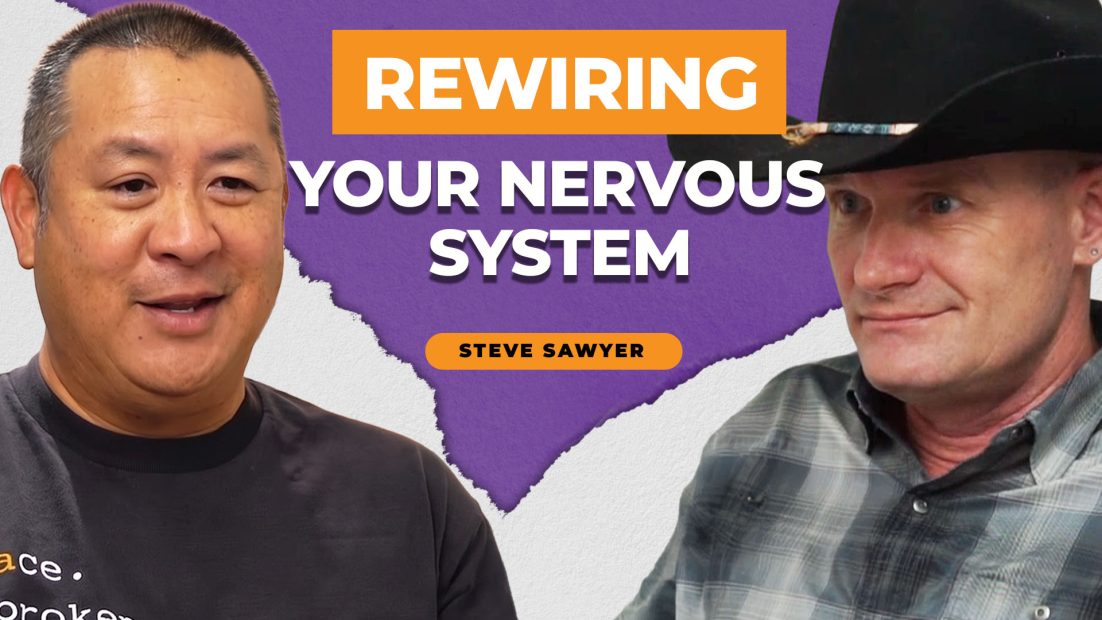
Overcome Childhood Trauma & Rewire Your Brain | Steve Sawyer
Steve Sawyer didn't arrive at his life's work through a textbook. He arrived through his own story — one it took him years of deep inner work to fully unpack. Growing up in a household defined by unpredictable rage, silence, and physical discipline, Steve lived in the constant tension between two equally terrifying extremes: explosive anger and its cold, suffocating opposite. His father, a military veteran carrying generations of unprocessed hurt, brought that pain into the home in ways young Steve couldn't name at the time. His mother, whom he describes as loving and deeply affectionate, was the foundation beneath him — and also someone who, in the moments that mattered most, couldn't intervene. It was the night the wooden spoon broke that something shifted, and Steve began to understand that what happened to him wasn't discipline. It was harm.
That early chapter didn't define him as a victim — it defined him as a witness to how pain travels through families. Steve went on to become a licensed psychotherapist, a trauma trainer recognized nationwide, and the founder of the Developmental Trauma Training Institute. He has trained alongside Gabor Maté and Bessel van der Kolk, co-authored the HeartMath Interventions program, and spent two decades in the trenches of wilderness therapy, treating roughly 2,000 young people at the end of their rope. His own healing — and his own recovery from addiction — is the beating heart behind everything he teaches.
The Attachment Cycle: Where It All Begins
At the core of Steve's work is a deceptively simple idea: every human being is born into the world with needs. When a baby cries, its nervous system is aroused — it's signaling for something. What happens next writes the very first chapter of that child's relationship with other people. An attuned caregiver responds — not perfectly, but consistently and with warmth — and the nervous system learns a foundational truth: I ask for help, and people show up. That calming cycle, repeated thousands of times in the early years, becomes the blueprint for trust.
When that cycle breaks down — through neglect, aggression, inconsistency, or emotional unavailability — the nervous system doesn't just feel disappointed. It embeds dysregulation at its roots. The child's nervous system learns a different lesson: people don't respond, or they respond with danger. From that early wiring come the patterns we see in adults — fierce independence, the inability to ask for help, the drive to self-soothe through food, substances, work, exercise, or scrolling. Steve is clear: this is not a character flaw. It is a logical, adaptive response to an unsafe beginning.
What Developmental Trauma Actually Is
Developmental trauma isn't only what we typically imagine — obvious abuse or neglect in a chaotic home. It begins earlier than most people realize. Steve points out that a fetus can recognize its mother's voice at just 19 days post-conception. A baby adopted at birth has already formed a bond with that voice — and losing it creates a grief the nervous system holds long before the child has language to describe it. Trauma can be passed through the womb, through generational patterns, and through the quiet, invisible messages embedded in how a household functions.
Even in homes without overt abuse, developmental trauma can take root. The child who can never quite measure up to highly achieving parents. The kid who watches a sibling excel while they quietly believe they never will. The unspoken household message of I'm only good if, and I'm only good when — those conditional signals that tie a child's sense of worth to performance, achievement, or approval. Steve invites every listener, regardless of how their childhood looked from the outside, to ask themselves that question honestly: what was the message?
The Four Core Wounds
Drawing on the work of Anna Freud, who studied both World War II veterans and orphaned children, Steve describes four survival mechanisms that sit at the deepest roots of human suffering. The first is fear of annihilation — the overwhelming terror that we will not survive what is happening. The second is fear of abandonment — the raw, wordless dread of being left behind by the pack, without any reason why. The third is rejection — being cast out with a reason, the message that something specific and fundamental is wrong with us. And the fourth is fear of humiliation — not only being rejected, but being publicly mocked for it, with the whole pack uniting behind the derision.
These four wounds are not abstract psychological concepts. They are survival mechanisms embedded in the body, and when they are triggered, the nervous system responds as though the original threat is happening right now. Steve has worked with suicidal teenagers who were humiliated by a single viral video, young people who felt they were dying not because of any physical threat, but because their nervous system registered social exclusion as annihilation. Understanding these wounds doesn't just explain suffering — it points directly toward what healing actually requires.
The Nervous System's Gas and Brake
Steve explains the nervous system through the metaphor of a gas and a brake. Hyperarousal — the gas stuck on — is anxiety, reactivity, and the constant hum of threat. This is the sympathetic state, the body running and running without ever finding rest. But the less-discussed opposite is hypoarousal — the brake stuck on — which manifests as depression, disconnection, shutdown, and what Steve calls the dorsal vagal collapse. He describes it through the striking image of a gazelle caught between two cheetahs: first the freeze, the body locking up in indecision. Then, if escape is impossible, the body goes limp — submitting, giving up. It's the organism's last survival strategy.
In humans, this collapse doesn't look dramatic. It looks like not being able to get out of bed. It looks like doing something you used to love and feeling nothing. The shroud, Steve calls it — a lens that strips all brightness from the world. What the Western medical model often does is treat this symptom: antidepressants can lift the brake just enough to function. But unless the underlying stress load that drove the system into collapse is addressed, coming off the medication returns you to where you were. The brake was always just a signal. The real work is in what loaded the system in the first place.
Move It, Don't Soothe It
One of the most important distinctions Steve makes in this conversation is between soothing trauma and actually moving it. Running, overworking, exercise, prayer, meditation — these can all take the edge off arousal. They release pressure from the nervous system temporarily. But the roots remain. The developmental stress is still embedded in the body, still coiled in the midbrain, still waiting. Steve describes how he himself was a runner — a vindictive runner, as he calls it — burning through his rage on the road. It helped him not hurt anyone. But it didn't take him to the wound.
True healing, Steve argues, requires going toward the trauma — not around it, and not just soothing it from the outside. The brain knows how to heal itself. Animals shake off stress naturally after a threatening event. Humans, with our powerful frontal lobes, think our way around the pain instead of moving it through. The right therapeutic environment — an attuned, regulated practitioner who can hold space without an agenda — allows the nervous system to do what it's actually designed to do. Steve is emphatic that this doesn't have to take decades. The brain is wired for rapid release when the conditions are right. The work isn't endless. It's directional.
The Opposite of Addiction Is Connection
Steve often cites the phrase: the opposite of addiction is connection. Addiction, in his framing, is not primarily about substances. It is the nervous system reaching for anything — food, work, screens, gambling, perfectionism, exercise — that can temporarily calm an arousal it cannot soothe through human relationship. When the attachment cycle breaks down early and humans become associated with danger or abandonment rather than safety, the nervous system finds other regulators. The phone becomes the attachment figure. Social media becomes the stand-in for the face-to-face attunement of a parent and child. The likes and comments scratch the same itch — but they can never fully meet the need, because real heart-to-heart connection is the only thing that does.
Steve also draws a sharp line between achievement driven by love and achievement driven by shame. Shame, he says, is rocket fuel — it can power extraordinary performance for years. But it is always hollow at the center, always chasing a validation it can never quite reach. Love, by contrast, activates oxytocin — the body's chemistry of genuine connection and fulfillment. When we do something because we love it, people feel it. When we do it to prove we are enough, something essential is always missing — and even extraordinary success doesn't fill the gap.
Repair Better: Breaking the Chain
The most hopeful thread running through this entire conversation is also the most practical: the idea that breaking generational trauma doesn't require perfection. It requires repair. Steve shares a conversation with Gabor Maté that stopped him cold: Do you repair better than your family did? He didn't have to think long. His father never once said I'm sorry. Rage would erupt, and then silence would settle, and life would continue as though nothing had happened. That silence is what Steve had to consciously choose against — not by being a perfect parent, but by coming back.
There is, Steve explains, a 90-second window after a rupture where the nervous system is most available to receive repair. If a parent blows up, yells, frightens their child — and comes back within that window with genuine vulnerability, owns what happened, and invites the child's experience — the nervous system can actually rewrite what it stored in those first moments of fear. The chain can be broken, one repair at a time, at any age, in any family. Steve offers the story of an 88-year-old neuropsychiatrist who finally sought help late in life, repaired his marriage, and found a kind of peace he had never known. The message is not that we must get it right. The message is: it is never too late to go back and repair.
Do What You Love
Steve closes with something his cross-country coach told him when he was coming out of drug treatment, young and unsteady, and his aunt had just dismissed his dream of becoming a counselor: Do what you love and you'll never work a day in your life — and you'll have plenty of income to go with it. He went on to build three successful treatment programs and a training institute, and has touched thousands of lives. But the point, he says, is not the outcome. The point is where it came from.
When the motivation is love — true connection to what you are doing and why — the work sustains itself. When the motivation is shame, or proving something, or accumulating what the world says should make you feel good, it will never be enough. Steve has worked with billionaire families where children received fifth cars for their birthdays and all they wanted was their parents' hearts. He has sat with Fortune 500 executives who had everything and felt hollow. The answer was never more. The answer was always connection — to yourself, to the people you love, and to the work that calls you from the inside out. That, Steve says, is the foundation of a fulfilling life.
CLICK HERE to SUBSCRIBE to our YouTube channel
Podcast: Play in new window | Download
Subscribe: Apple Podcasts | Spotify | RSS