
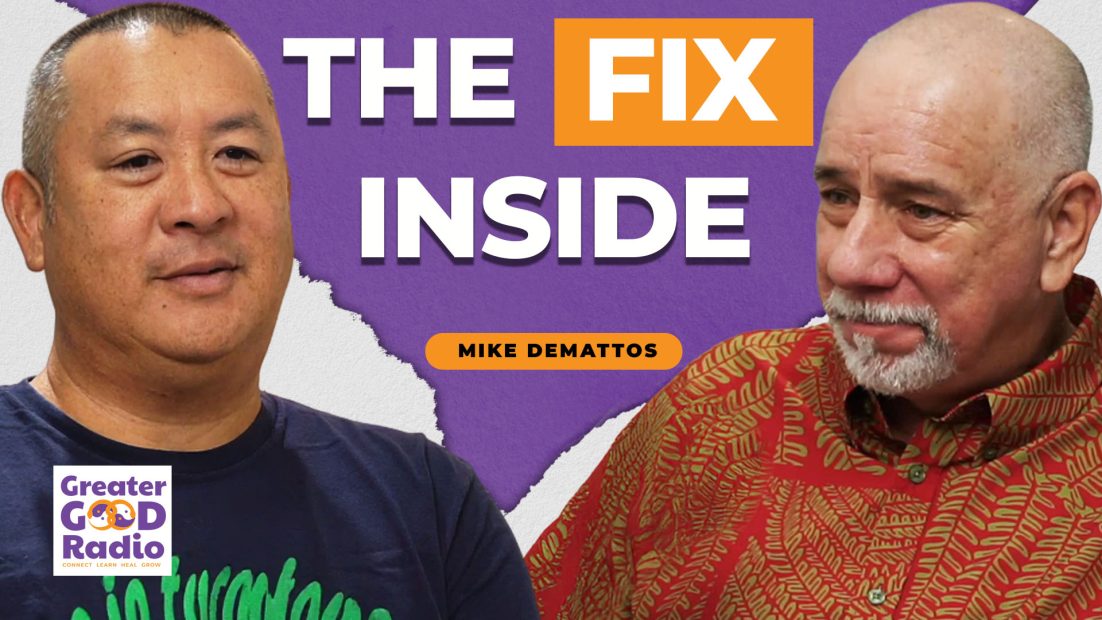
Psychedelic Therapy: Rewiring Trauma
⚠️ Content Advisory: This episode contains discussions of suicide, childhood abuse, violence, sexual abuse, and substance use. These topics are explored with honesty and care, but may be difficult for some readers. Please take care of yourself. If you or someone you know is struggling, help is available by calling or texting the 988 Suicide and Crisis Lifeline.
What If the Problem Isn't the Problem?
Most of us have been taught that mental health struggles are problems to be fixed — diagnoses to be managed, symptoms to be suppressed. But Dr. Mike DeMattos, BSW Program Chair at the University of Hawaiʻi at Mānoa's Thompson School of Social Work, opens this conversation with a different frame entirely. What if anxiety, depression, OCD, and substance misuse aren't broken parts of us, but rather patterns that made sense at some point — and simply got stuck?
"When you live with anxiety or depression, you're on a carved path," Mike explains. "What psychedelics may do is offer new snow." It's a striking metaphor: the brain, like a ski slope, tends to follow the routes already cut into it. Trauma and chronic stress carve those grooves deeper. But emerging research suggests that certain psychedelic compounds — psilocybin, MDMA, ketamine — may offer the brain a rare opportunity for neuroplasticity: a chance to lay down new snow, new pathways, new ways of seeing the world.
Tuning In, Turning Toward
One of the most powerful concepts in this conversation is what host Evan Leong calls "tune in, turn toward" — a philosophy born from his own experience with plant medicine. For most of us, the instinct when something is painful is to turn away from it: numb it, distract from it, suppress it. But as Mike points out, suppression is actually the prescription for making things worse.
The therapeutic power of psychedelics, Mike suggests, lies in their ability to create a kind of internal anesthesia — not to erase the pain, but to make it bearable enough to face. "A memory without the emotional charge becomes wisdom," Evan reflects. And Mike agrees: "Trauma is the meaning that we make out of an event. Psychedelics may offer us the opportunity to make new meaning." The goal isn't to forget what happened. It's to reach a place where the past no longer drives you — where it can become a source of wisdom rather than a source of suffering.
The Wound Beneath the Wound
With nearly 30 years as a social worker and family therapist, Mike has seen up close what lies beneath most of the struggles people bring into a therapist's office. His answer is surprisingly consistent: self-rejection. "Being unsatisfied with who I am, where I am, when I am," he says. And at the root of that self-rejection, almost universally, is some form of early wounding — often carried silently, often unrecognized.
He's careful to distinguish between a traumatic event and the experience of trauma. Five people can go through the same event, and not all of them will be traumatized. What makes the difference, he explains, is whether someone had a person present to help them process it — to co-regulate, to hold space. "You get hurt in groups," Evan reflects, "so you need to heal in groups." Mike nods: everything meaningful in our lives happens in relationship. And almost everything painful does too.
The Wounded Healer
Mike doesn't speak about this work from the outside. He grew up on the Leeward Coast of Oʻahu in a household marked by violence, instability, and survival — not the kind of environment where a child had room to ask how they were doing in math class. School was respite. Psychology, when he discovered it in high school, gave him language for what he had lived.
That language led him to social work, and eventually to work with adolescents — a population he initially resisted. But he didn't stay at arm's length from his own story. Early in his career, he nearly missed a client's suicide attempt — and when he sat with why, he traced it back to growing up with a mother who had suicidal ideation, who told him as a second grader that she might not be there when he got home. As a child, he had somaticized the terror: his second-grade report card shows 57 missed days of school. As an adult clinician, that old wound had made it almost impossible to see what was right in front of him.
It was a turning point. "I was not ready to be present with it," he says, "because I was never ready to be present with it." He found a therapist. He stayed in therapy. He did the work — slowly, over decades, through Internal Family Systems (IFS) and other modalities — until, not long ago, something finally shifted. An IFS session in which a long-imprisoned inner child walked free. A breakdown of tears. A walk down the street afterward where everything — the green of the leaves, the blue of the sky — looked somehow brighter and more vivid than it ever had before.
Healing Is Relational
One of the quieter through-lines of this conversation is a critique of the way Western culture approaches struggle: alone, with grit, through willpower. Mike pushes back on the "resiliency movement" when it's framed as personal fortitude. "Resiliency born and bred in community — that's where healing can occur," he says. Whether it's substance recovery, family therapy, or psychedelic-assisted treatment, what the research consistently shows is that community and connection are at the center of what actually works.
That extends to the therapeutic relationship itself. Mike is direct: a good therapist is someone who has done their own healing work. Not someone who is perfect, but someone who has been through their own fire and come out the other side with awareness — and with enough capacity to sit with your pain without flinching, without deflecting, and without making it about themselves.
A New Frontier in Social Work
Mike's work at UH Mānoa is placing Hawaiʻi at the leading edge of a growing national conversation. Through a fellowship with the University Psychedelic Education Program (U-PEP), he is developing coursework to prepare the next generation of social workers to meet clients wherever they are — whether those clients are exploring psychedelics recreationally or accessing them therapeutically. Until recently, psychedelics only appeared in social work curricula as cautionary tales. Mike is working to change that.
"Social workers provide the bulk of mental health services in the U.S.," he has said. The compounds he's advocating to teach about — psilocybin, MDMA, and others — have received breakthrough therapy designations from the FDA for conditions like PTSD and treatment-resistant depression. If the research holds, and early indicators suggest it will, social workers need to be ready. Mike intends to make sure they are.
Living It, Not Just Teaching It
Perhaps what makes this conversation linger is that Mike doesn't just teach healing — he practices it in the most intimate corners of his life. He and his wife of over 36 years hold family ceremonies: a ritual space in their home, stripped of furniture, with mats representing the four elements, where any family member can call for a gathering to mark what matters. Grief, celebration, transition — all of it gets held in ceremony. It is, he says, the central component of the success of their relationship.
He closes the conversation with a hope that is both personal and professional: that psychedelic medicine might help more of us access our pain, make it bearable, and bear it together. "Life isn't easy," he says. "The medicine isn't gonna make the difficulties of life go away. It's gonna make it so that we can bear those — and we can bear those in community, together."
That, ultimately, is what this episode is about. Not a drug. Not a shortcut. But a doorway — into the parts of ourselves we've locked away, and back into the kind of connection that makes us whole.
CLICK HERE to SUBSCRIBE to our YouTube channel
Podcast: Play in new window | Download
Subscribe: Apple Podcasts | Spotify | RSS